
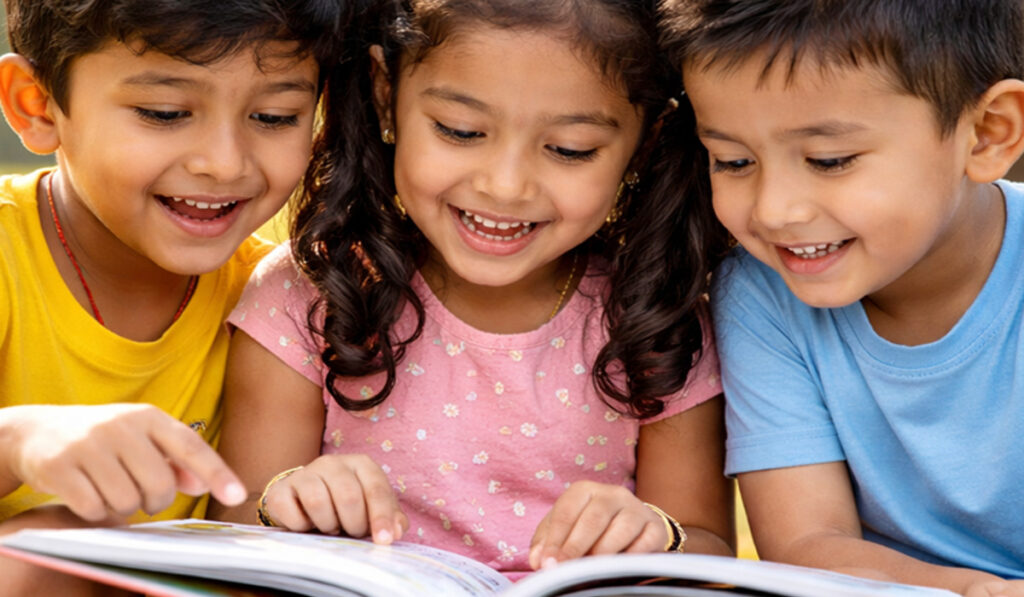
Walk into any bookstore in Kathmandu today and you will feel it immediately: movement. Shelves are fuller than ever. Bright covers compete for attention. New authors are launching titles every month. On the surface, it feels like a golden age for Nepali children’s literature.
But if we pause and look more closely, a harder question emerges: are we building a lasting literary culture for children, or are we simply increasing the number of printed pages?
We are growing in quantity. But are we growing in quality?
The Illusion of Progress
The rise in children’s book production in Nepal is not accidental. Literacy campaigns, curriculum reforms, and the expanding reach of private schools have all created demand. Publishers have responded with enthusiasm. Writers, illustrators, and designers are entering the field with energy.
Yet growth in numbers does not automatically mean growth in depth.
Too many books feel rushed—produced to fill a market gap rather than to fulfill a creative vision. Stories often follow predictable patterns, recycle common moral lessons, or imitate foreign plots without cultural grounding. The language sometimes swings between being overly simplistic and unnecessarily complex, failing to match a child’s cognitive stage.
Children notice this, even if adults don’t. They can sense when a story speaks to them—and when it talks down to them.
The “NGO Trap”: When the Buyer Isn’t the Reader
One of the most significant shifts in the Nepali children’s book ecosystem has been the role of NGOs and development organizations. Their mission is admirable: to increase access to reading materials, especially in underserved communities. Their bulk purchases have helped many publishers survive and expand.
However, this model has quietly reshaped the creative process.
When the primary buyer is an institution with a checklist—topics like hygiene, climate change, social inclusion, or financial literacy—the writer often begins to write for the checklist. The story becomes secondary. The message becomes primary.
The result? Books that feel like manuals dressed up as stories.
A child does not open a book thinking, “I hope this improves my awareness of sanitation policy.” A child opens a book seeking wonder, laughter, suspense, connection. When narrative is sacrificed for instruction, the magic disappears.
Educational themes are important. But if they are not embedded naturally within compelling characters and believable conflicts, children disengage. A book may satisfy a project report, but it will not nurture a lifelong reader.
The Rise of the “Instant Expert”
Another troubling pattern is the emergence of what might be called the “instant expert.”
A new writer publishes four or five titles within a short period and is quickly invited to lead workshops, judge competitions, or mentor aspiring authors. On paper, productivity is celebrated. But writing children’s literature is not a numbers game. It is a craft that demands immersion, patience, and humility.
In global literary traditions, great children’s authors often spend years refining their voice. They read hundreds of classics and contemporary works. They study narrative rhythm, child psychology, humor, and pacing. They revise relentlessly.
When mentorship comes from creators who have not deeply studied the craft, a cycle of mediocrity begins. Simplistic storytelling techniques are repeated. Structural weaknesses are normalized. Over time, the standard quietly lowers.
The danger is not that new voices are entering the field. That is healthy. The danger is mistaking speed for mastery.
The Translation Crisis and Cultural Authenticity
Another subtle issue is the rise of “inspired” stories that are thinly veiled adaptations of popular English-language books. Plots are borrowed, character arcs are mirrored, and even metaphors feel foreign to Nepali contexts.
Sometimes this happens unconsciously. Writers who consume mostly translated or imported material may internalize foreign narrative frameworks without realizing it.
But children deserve stories rooted in their own landscapes—mountain villages, urban Kathmandu alleys, Terai farmlands, migrant family experiences, festivals, grandparents’ tales, and everyday school life. Authenticity is not about rejecting global influence. It is about transforming it through a local lens.
A strong children’s literature ecosystem balances universality and cultural specificity. A child in Pokhara should see reflections of their world on the page, not just distant echoes of another country’s imagination.
The Literacy Gap: When Books Don’t Match the Reader
Quality in children’s literature is not only about beautiful illustrations or moral messages. It is about developmental appropriateness.
A seven-year-old reader has specific linguistic capabilities. Sentence length, vocabulary difficulty, narrative complexity, and emotional themes must align with that stage. When books ignore this, two things happen: children feel frustrated, and teachers quietly stop using the material.
Field testing is rare in our publishing culture. Manuscripts often move directly from writer to printer, with minimal editing and no classroom validation. But children are the ultimate critics. If they lose interest after two pages, that is not a failure of attention span—it is feedback.
Testing stories with real readers should not be optional. It should be standard practice.
The Discipline of Excellence
If we want Nepali children’s literature to thrive—not just survive—we need a cultural shift in how we define success.
Read before you write. A powerful rule might be the “100-to-1 ratio”: read one hundred excellent children’s books for every one you attempt to publish. Exposure to diverse styles, voices, and structures deepens creative instincts.
Invest in professional editing. Editors are not obstacles; they are partners. A strong editor understands narrative flow, child psychology, and linguistic nuance. They protect the reader’s experience. Publishers must see themselves not as printers, but as curators of quality.
Value time over speed. A book that takes two years to refine may outlive ten rushed titles. Longevity should matter more than launch events.
Test with children. Classrooms, reading circles, and library sessions can reveal what no adult committee can predict. Children’s reactions—laughter, boredom, curiosity—are the most honest indicators of quality.
A Turning Point for the Future
The current moment is not a crisis—it is an opportunity.
The energy in Nepal’s literary scene is vibrant. There are talented illustrators experimenting with bold visual styles. There are educators passionate about literacy. There are young writers eager to tell new stories.
But energy must be guided by standards.
Children’s literature is not a secondary genre. It is the foundation of a nation’s imagination. The stories children grow up with shape their empathy, creativity, language skills, and sense of possibility.
If we flood the market with books that merely exist, we miss the chance to inspire. If we commit to quality—rigorous editing, authentic storytelling, developmental awareness, and creative honesty—we build something lasting.
Our children do not need more books.
They need better books.
The future of Nepali children’s literature will not be defined by how many titles we produce each year. It will be defined by whether, twenty years from now, adults look back and say, “That story changed me.”
Let us choose depth over speed, craft over convenience, and excellence over adequacy. Our children deserve nothing less.