

When Should You Introduce Educational Toys to Your Baby?

A story every parent lives—just with different toys on the floor.
The first time your baby wraps their tiny fingers around your thumb, you realize something powerful: they are already learning.
Learning your face.
Learning your voice.
Learning the rhythm of the world.
And somewhere between midnight feedings and morning cuddles, a question quietly forms in your mind:
When should I introduce educational toys? Am I too early? Too late? Doing enough?
Let’s walk through this together — not as a checklist, but as a journey.
Why the First Years Matter So Much
According to the Center on the Developing Child at Harvard University, more than 1 million new neural connections form every second during the first few years of life. By age 3, a child’s brain reaches about 80–90% of its adult size.
That means your baby’s early experiences — what they see, hear, touch, and explore — literally shape their brain architecture.
But here’s the comforting truth:
Educational toys are not about pushing academics early.
They are about supporting natural development at the right time.
So when should you introduce them?
The answer is simpler than you think.
0–3 Months: The World Is Brand New
In the early months, your baby isn’t “playing” in the traditional sense. They are absorbing.
Research shows newborns see best at 8–12 inches away — roughly the distance from your arms to your face. Their vision is blurry, and they respond strongly to high-contrast patterns (especially black and white).
What Their Brain Is Learning:
- Visual tracking
- Sound recognition
- Early sensory processing
- Bonding and emotional security
Ideal Educational Toys:
- High-contrast cards or books
- Soft rattles
- Musical mobiles
- Textured sensory fabrics
At this stage, you are the best educational toy. Your voice, your smile, your touch.
3–6 Months: Reaching for the World
Around 3 months, something magical happens.
Your baby realizes:
“I can move my hands… and they do things.”
The American Academy of Pediatrics notes that between 4–6 months, babies develop coordinated reaching and begin exploring objects intentionally.
What’s Developing:
- Hand-eye coordination
- Cause and effect understanding
- Muscle strength (especially during tummy time)
Best Toys Now:
- Activity mats with hanging toys
- Teething rings
- Soft balls
- Toys that make gentle sounds when shaken
These toys help strengthen neural pathways connecting vision and motor control.
6–12 Months: The Curious Explorer
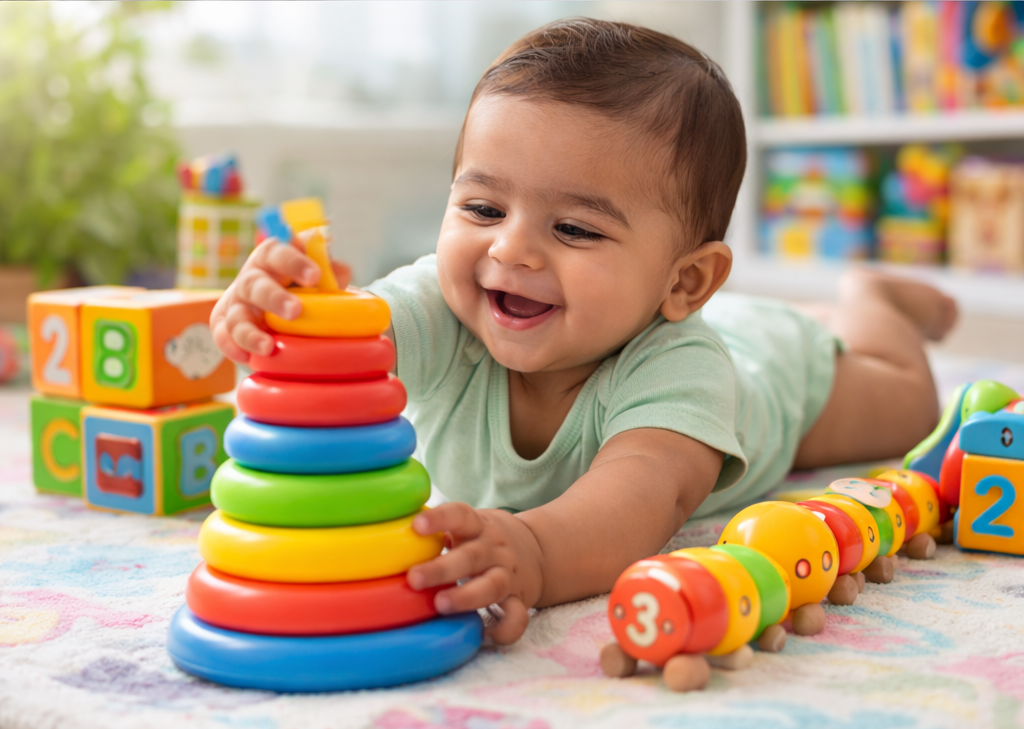
Now your baby drops things on purpose. Again. And again.
They’re not trying to test your patience. They’re studying gravity.
Between 6–12 months, babies develop object permanence — understanding that something exists even when they can’t see it (a milestone identified by developmental psychologist Jean Piaget).
Brain Growth at This Stage:
- Problem-solving begins
- Memory improves
- Early reasoning skills form
Educational Toys That Shine:
- Stacking rings
- Nesting cups
- Shape sorters
- Simple board books
Research published in Pediatrics found that babies exposed to regular shared reading as early as 6 months show improved vocabulary development by 18 months.
So yes — reading counts as educational play.
12–18 Months: Words, Wonder, and “Mine!”
Your baby is now becoming a communicator.
Most children say their first word around 12 months, and vocabulary expands rapidly after that. By 18 months, many toddlers understand 50+ words.
What’s Happening Developmentally:
- Language explosion
- Social awareness
- Early pretend play
Toys That Support This:
- Pretend kitchen sets
- Dolls
- Animal sound toys
- Picture books
Symbolic play (pretending a block is a phone) is strongly linked to later language and cognitive development.
This is when toys become tools for imagination.
18–24 Months: “I Do It!”
Fine motor skills improve rapidly between 18–24 months. According to CDC developmental milestones, toddlers begin stacking blocks, turning pages, and scribbling.
Skills Developing:
- Finger strength
- Coordination
- Early problem-solving
- Emotional regulation
Ideal Educational Toys:
- Building blocks
- Large-piece puzzles
- Threading toys
- Thick crayons
These activities strengthen the small muscles needed later for writing.
2 Years and Beyond: Big Movement, Big Ideas
Physical activity isn’t just exercise — it builds neural integration. Studies show active play enhances executive function skills like focus and impulse control.
Development Focus:
- Balance and coordination
- Imaginative storytelling
- Early counting and sorting
Great Educational Toys:
- Tricycles
- Push-and-pull toys
- Balls
- Outdoor climbing equipment
Movement feeds the brain.
So… When Should You Introduce Educational Toys?
Here’s the simple answer:
From birth — but aligned with development.
Educational toys aren’t about flashcards or forcing milestones.
They are about:
- Matching toys to brain readiness
- Encouraging curiosity
- Supporting natural growth
The key isn’t how early.
It’s how appropriate.
What the Research Really Says About Toys
Here are important data-backed insights many parents don’t hear:
- Fewer, simpler toys often lead to deeper focus and longer play sessions (University of Toledo study, 2018).
- Parent interaction during play significantly increases learning outcomes.
- Electronic toys with excessive lights and sounds can reduce language interaction compared to traditional toys.
- Open-ended toys (blocks, pretend play items) support creativity more than single-function toys.
The best “educational toy” is one that invites interaction — not one that replaces it.
A Gentle Reminder for Every Parent
You do not need the most expensive toy.
You do not need shelves overflowing with gadgets.
You need:
- Engagement
- Conversation
- Encouragement
- Age-appropriate tools
Educational toys are powerful — but they work best when paired with your presence.
The Takeaway
Introduce educational toys from the very beginning —
but choose them thoughtfully as your baby grows.
Each stage builds on the last:
- Sensory exploration
- Motor skills
- Problem-solving
- Language
- Imagination
- Physical confidence
When toys match development, they become more than objects.
They become stepping stones.
And before you know it, that tiny hand gripping your finger will be stacking blocks, turning pages, riding tricycles — building not just skills, but a foundation for lifelong learning.